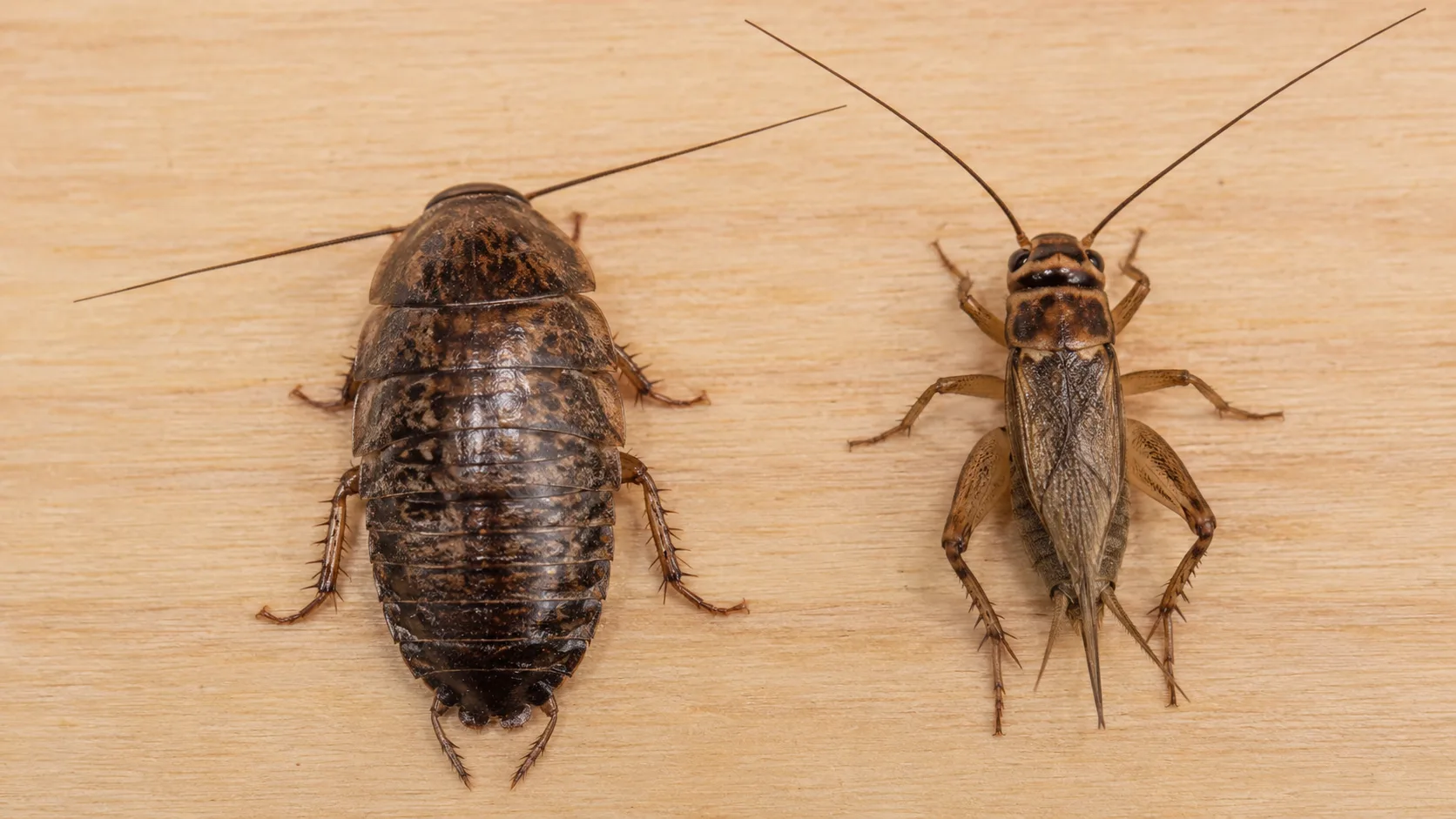
Dubia roaches or crickets for a bearded dragon — which is better?
Short answer
Dubia roaches beat crickets on almost every measurable criterion for bearded dragons: 2–3× the protein and calcium per gram, longer shelf-life (weeks vs days), quieter, less smelly, and no escape risk. Crickets win only on availability and price. Use dubia as the staple feeder for juveniles and adults; offer crickets as variety. Avoid all-mealworm diets either way.
- Author
- Reptimo Editorial
- Updated
- Updated
- Reading time
- 5 min read
The honest framing
Dubia roaches beat crickets on almost every measurable criterion for feeding bearded dragons. The ReptiFiles bearded dragon feeding guide and the Dubia Roaches feeder nutrition comparisons converge on a clear picture: dubia deliver more usable protein, better calcium, longer shelf-life and fewer household hassles than crickets. The case for crickets is mostly availability and lower upfront cost.
This guide compares the two, plus the other feeders worth rotating in. Most committed bearded dragon keepers eventually move dubia to staple and use crickets as variety; understanding why is the point of the comparison.
Nutrition head to head
Care parameters
Dubia vs cricket — nutrition (approximate, per gram dry weight)
| Parameter | Recommended value | Notes |
|---|---|---|
| Protein | Dubia ~21–23 % · Cricket ~18–20 % | |
| Fat | Dubia ~9 % · Cricket ~6 % | |
| Calcium | Dubia higher when gut-loaded · Cricket adequate when dusted | |
| Ca:P ratio (un-gut-loaded) | Dubia ~1:3 · Cricket ~1:9 (both need correction) | |
| Meat-to-shell ratio | Dubia higher (less chitin per gram) | |
| Moisture | Dubia ~62 % · Cricket ~70 % |
Both feeders need calcium dusting and gut-loading regardless of which you use — neither alone provides a Ca:P ratio bearded dragons need. The dubia advantage is mostly in usable protein per gram (less chitin to digest) and the better starting Ca:P ratio.
The practical case
This is where dubia widen the gap dramatically:
Care parameters
Practical comparison
| Parameter | Recommended value | Notes |
|---|---|---|
| Shelf-life (uneaten) | Dubia ~1–2 months in tub · Cricket 7–14 days before die-off | |
| Smell | Dubia minimal · Cricket strong if any die | |
| Noise | Dubia silent · Cricket loud chirping | |
| Escape risk | Dubia none (can't climb smooth surfaces) · Cricket high | |
| Bite risk | Dubia very low · Cricket can bite small reptiles | |
| Breeding | Dubia self-sustaining colony · Cricket nearly impossible at home | |
| Cost per feeder (bulk) | Dubia $0.15–0.30 · Cricket $0.05–0.15 |
Crickets are cheaper at point of sale; dubia are cheaper over time because almost none die uneaten and a starter colony self-replenishes.
When crickets are the right choice
Crickets aren't bad — they're nutritionally adequate and have a case in specific situations:
- Hunting enrichment. Crickets move erratically and trigger more active hunting behaviour, which some keepers value for juvenile dragons.
- Availability. Crickets are stocked at virtually every pet store; dubia require online order or specialist stores in many regions.
- Legal restrictions. Florida prohibits dubia; verify local rules elsewhere.
- Cost-sensitive setups. For a single juvenile dragon, $5/week of crickets is cheaper than starting a dubia colony.
The honest summary: crickets work fine if you're willing to manage the practical downsides. Dubia work better if you can.
Other feeders worth rotating in
A dragon on dubia-only is better off than one on cricket-only, but both are worse than one on a varied rotation:
Care parameters
Bearded dragon feeder rotation
| Parameter | Recommended value | Notes |
|---|---|---|
| Dubia roach | Staple — 50–60 % of insect feedings | |
| Crickets | Variety — 20 % · hunting enrichment | |
| BSF larvae (phoenix worms) | High calcium — 10 % · pre-loaded with Ca, no dusting needed | |
| Hornworm | Hydrating — occasional · grows fast, watch size | |
| Silkworm | High quality — occasional · seasonal availability | |
| Mealworm / superworm | Treat only · high chitin, hard to digest, calcium-poor | |
| Waxworm | Rare treat · very high fat, addictive |
Mealworms are popular but should be occasional treats. Their chitin shell is hard to digest, calcium content is poor, and dragons develop a "junk food" preference that makes returning to staple feeders harder.
Don't feed only one species
Even with dubia as staple:
- Variety prevents nutritional gaps. Each feeder has slightly different micronutrient profile.
- Reduces feeder boredom. Dragons are individuals; some lose interest in a single feeder over months.
- Increases hunting engagement. Different feeders move differently and trigger different hunting behaviours.
- Provides hydration. Hornworms and BSF larvae are higher moisture than dubia or crickets.
A typical weekly rotation for an adult: Mon dubia + greens, Wed crickets + greens, Fri dubia + greens, plus occasional BSF larvae or hornworms instead.
Starting a dubia colony
A 30-litre plastic tub with vented lid, stacked vertical egg-crate flats, a 7×7 in heat mat on one wall (set to 75–85 °F via thermostat), and weekly fresh greens supports a colony of 100+ dubia indefinitely.
- Starter colony: 25 adult females + 5 males. Breed slowly; takes 4–6 months to ramp.
- Maintenance feeding: carrots, sweet potato, apple, dark leafy greens, plus a commercial gut-load powder.
- Water: water crystals (polymer) — dubia drown in open water.
- Maintenance: weekly fresh food, monthly bottom-tub clean, separate nymphs from adults if you want faster breeding.
The setup pays off within a year — you stop buying weekly cricket batches and have a constant supply.
Where to buy dubia
Online specialist suppliers ship live in insulated boxes:
- US: Dubia.com, Topflight Dubia, RoachCrossing.
- UK / EU: Dubia Roaches UK, Northampton Reptile Centre, livefoods.co.uk, similar regional suppliers.
Many reptile expos sell starter colonies. Avoid generic pet-store chains — selection and freshness vary.
Putting feeding into context
For the full bearded dragon feeding cadence by age, see bearded dragon feeding frequency. For the broader diet picture including greens, see bearded dragon diet. For the cross-species feeding framework, see reptile feeding schedules.
Frequently asked questions
Why are dubia roaches considered better than crickets?
Are dubia roaches legal where I live?
Are crickets bad for bearded dragons?
How many dubia roaches should I feed a bearded dragon?
What size dubia roach for a bearded dragon?
Can I feed only dubia roaches?
How do I gut-load dubia roaches?
Are dubia roaches harder to keep than crickets?
Where can I buy dubia roaches?
Sources
- Bearded Dragon Diet · ReptiFiles
- Bearded Dragon Care Sheet · PetMD
- Feeder Insect Nutrition Comparisons · Dubia Roaches
Quick check
Test what you just learned
A short quiz, just for you. Pick an answer to get instant feedback — there's no pass mark, this is for your benefit.
Quiz questions and answers
Which feeder is more calorically dense and calcium-rich for a bearded dragon, gram for gram?
Correct answer: Dubia roaches
Dubia roaches contain ~21–23 % protein with a better Ca:P ratio and higher meat-to-shell ratio than crickets. They deliver more usable nutrition per gram, gut-load reliably, and live for weeks in colony. Crickets and mealworms come second and third.
What's the right way to mix feeders for a bearded dragon?
Correct answer: Dubia as staple, with crickets / BSF larvae / hornworms / silkworms as weekly variety; mealworms as occasional treats
Variety prevents nutritional gaps and reduces feeder boredom. Dubia as staple gives the best baseline; crickets, BSF larvae, hornworms and silkworms add hydration, calcium and behavioural enrichment. Mealworms only as occasional treats — high chitin, hard to digest, calcium-poor.
What's the biggest practical advantage of dubia roaches over crickets for a household?
Correct answer: Dubia live for months in colony with no smell, no chirping, no escape risk — versus crickets that smell, chirp, escape and die in days
The practical case for dubia is overwhelming: longer shelf-life (weeks to months), no chirping, minimal smell, can't climb smooth surfaces (no escape risk), no die-off in batches. Crickets are nutritionally fine but practically a hassle. Most committed keepers eventually switch.